Introduction
Wire mesh looks simple until you're the one specifying it. This engineered material shows up everywhere: filtration housings, security fencing, EMI shielding, industrial screens. Yet no two applications call for the same construction.
Oil and gas, pharmaceuticals, and electronics all demand tighter tolerances, longer service life, and materials that hold up under harsher conditions. Get the mesh type wrong, and you're looking at premature failure, particle bypass, or a costly reorder.
This guide breaks down the five main wire mesh construction types: woven, welded, expanded, knitted, and perforated, and shows you how to match each one to the right application, environment, and budget.
Key Takeaways
- Construction method determines strength, flexibility, and porosity, not material alone
- Material choice (stainless, copper, alloys, polymers) adds corrosion and temperature resistance
- Woven and welded mesh suit filtration and structure; knitted mesh fits compressible, high-porosity jobs
- Matching mesh to application and environment matters more than picking whatever's most common
- ISO-certified makers can engineer mesh to exact tolerances instead of a standard catalog fit
What Is Wire Mesh?
Wire mesh is a structure made from metal or polymer wires joined into a controlled pattern of openings. Wires can be woven, welded, knitted, or formed through expansion or perforation, and that construction method is what actually defines the "type."
Material matters too. But two mesh products made from identical stainless steel can behave completely differently depending on whether the wires are interlaced like fabric or fused solid at every intersection.
Wire mesh is a functional component engineered for a specific job, not a single generic product. Common roles include:
- Filter medium for gas or liquid separation
- Structural reinforcement in composites and insulation
- Shielding layer for EMI/RFI control
- Screening surface for sizing and protection
Why Wire Mesh Type Matters
The construction method directly affects filtration efficiency, load-bearing capacity, flexibility, and how the mesh handles corrosion over time. Pick the wrong type, and the consequences surface fast.
According to Haver & Boecker, mesh opening size and wire diameter create a direct trade-off. Smaller openings improve particle retention but raise resistance and pressure drop. Larger openings improve flow but risk letting unwanted particles through.
Thicker wire adds durability but reduces open area. Thinner wire increases flow but wears faster under stress.
Get that balance wrong, and you'll typically see:
- Premature mesh failure under mechanical or thermal stress
- Inconsistent filtration or particle bypass
- Poor airflow and climbing pressure drop
- Higher maintenance and replacement costs from blinding or clogging
None of this is theoretical. A separator built with the wrong mesh construction can mean unplanned downtime and re-engineering costs that dwarf the original price of the mesh. Sorting out these differences before you specify, rather than after installation, is what prevents that scramble.
Types of Wire Mesh
Wire mesh isn't one-size-fits-all. The construction method, whether woven, welded, expanded, knitted, or perforated, determines how the mesh handles strength, flexibility, and porosity. Each method produces a different product.
Choosing correctly starts with one question: is the priority structural strength, filtration precision, flexibility, or shielding performance? The five types below answer that question differently.

Woven Wire Mesh
Woven wire mesh is made by interlacing wires over-and-under on a loom, much like fabric weaving. Common variants include plain weave, twill weave, and Dutch weave, each producing a different balance of opening size and strength. Wire diameter and weave pattern together determine mesh count, aperture size, and flow characteristics.
What sets it apart: there's no fusing at the intersections. Strength and shape come purely from the interlacing pattern, which is also why ASTM E2016 excludes Dutch weave from its normative scope. Fine filter weaves are typically governed by manufacturer specifications rather than a single industry standard.
- Best suited for: filtration, sieving, screening, and architectural infill panels
- Key strength: precise, consistent aperture control across a wide range of mesh counts
- Trade-off: less rigid than welded mesh; wires can shift or loosen under sustained mechanical load
Welded Wire Mesh
Welded wire mesh starts with parallel wires laid in one direction, crossed by perpendicular wires, then fused at every intersection using electric resistance welding. The result is a fixed grid rather than an interlaced fabric.
That permanent joint is the defining difference. Welded mesh holds its shape and dimensions under load in a way woven mesh can't, since there's nothing to shift or loosen at the crossings.
- Best suited for: security fencing, concrete reinforcement, animal enclosures, and machine guards
- Key strength: high structural strength and load-bearing capacity, with strong resistance to unraveling
- Trade-off: heavier and less flexible than woven mesh. Weld points can also corrode faster if the mesh is galvanized before welding, since the heat burns zinc off the joint
Expanded Metal Mesh
Expanded metal mesh comes from a single sheet of metal that's slit and stretched in one continuous process to form diamond or hexagonal openings. There are no separate wires involved, and no welding or weaving step at all.
That one-piece origin is what makes it structurally distinct: there are no joints to fail, because the entire product is one continuous piece of metal.
- Best suited for: walkways, safety guards, ventilated fencing, and machine enclosures where weight matters
- Key strength: high strength-to-weight ratio, no unraveling, and minimal material waste in manufacturing
- Trade-off: limited precision for fine filtration, and cut edges often need finishing for safe handling
Knitted Wire Mesh
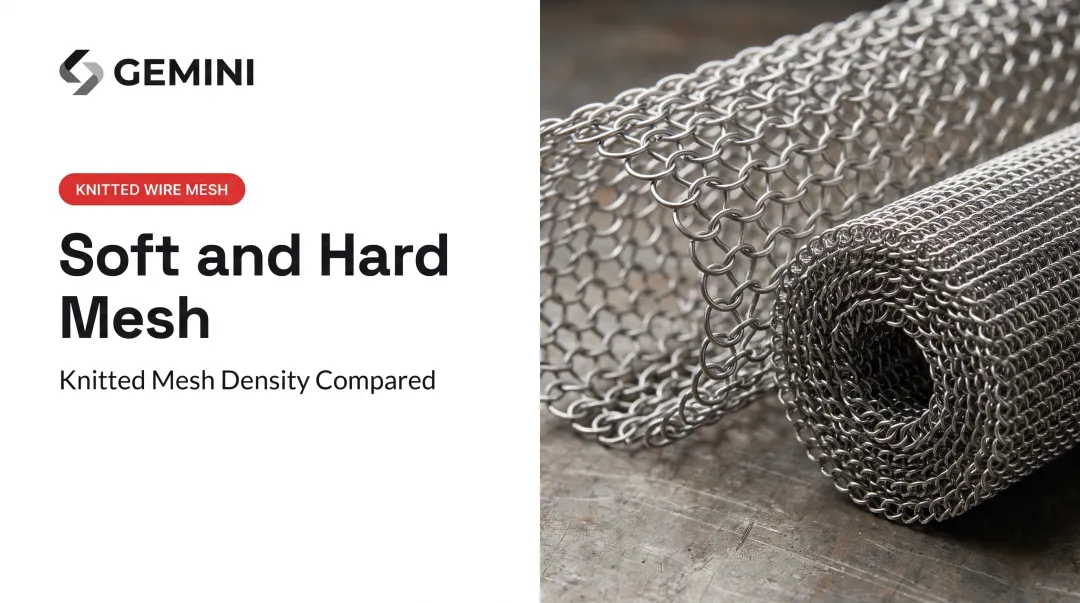
Knitted wire mesh is formed by looping and interlocking a continuous wire, similar to textile knitting, to create a compressible, three-dimensional structure instead of a flat grid. That structure is what lets density and porosity be engineered across an enormous range within a single mesh.
Gemini Wiremesh's knitted mesh, for instance, achieves up to 300% stretch capacity with void volume control ranging from near-zero to 98%, letting one base construction be tuned for very different jobs just by adjusting how tightly it's formed or compressed.
What sets it apart: unlike rigid, planar woven or welded mesh, knitted mesh is flexible and compressible, tuned to a target porosity rather than a fixed aperture size. Sulzer's KnitMesh mist eliminators illustrate this well: the knitted structure creates a tortuous path that separates droplets as small as 2 microns, typically at pressure drops below 2.5 mbar.
- Best suited for: demister pads, mist eliminators, filtration elements, EMI/RFI shielding, and insulation blanket facings
- Also valuable for: aggressive chemical environments, where specialty polymer knitted mesh such as PEEK replaces metal entirely
- Key strengths: near-infinite porosity control, high surface area for gas-liquid separation, and resistance to extreme temperatures and corrosive environments
- Trade-off: not built for structural or load-bearing use like fencing, and tight-spec custom runs require specialized knitting equipment that fewer manufacturers actually have
Perforated Metal Mesh
Perforated metal mesh starts as a solid sheet, then gets punched or stamped with holes in a chosen shape, size, and pattern. Technically, it isn't wire-based mesh at all; there's no wire, woven or otherwise, anywhere in the finished product.
That single-sheet origin is the key distinction: it's built from one stamped piece rather than interlaced, welded, or knitted strands.
- Best suited for: acoustic panels, architectural cladding, and ventilation covers where hole shape and appearance matter
- Key strength: wide design flexibility in hole shape and pattern, backed by strong single-sheet integrity
- Trade-off: heavier per unit area, with less fine porosity control than woven or knitted mesh
Here's how the five types compare at a glance:
| Type | Construction | Best For | Key Trait |
|---|---|---|---|
| Woven | Interlaced wires | Filtration, sieving | Precise aperture control |
| Welded | Fused intersections | Fencing, reinforcement | High structural strength |
| Expanded | Slit and stretched sheet | Walkways, guards | High strength-to-weight ratio |
| Knitted | Looped, interlocked wire | Mist elimination, shielding | Tunable, compressible porosity |
| Perforated | Punched sheet | Acoustic panels, cladding | Design flexibility in hole shape |
How to Choose the Right Type of Wire Mesh
The right mesh type depends on your application and operating conditions, not on which type shows up most often in a catalog. Work through these factors before specifying anything:
- Primary purpose: welded or expanded for structural/security work; woven or knitted for filtration; knitted for shielding and sealing
- Environmental exposure: match construction and material to temperature extremes, corrosivity, and moisture
- Precision requirements: define the aperture size, mesh count, or porosity range the job requires
- Production scale and budget: standard woven or welded rolls for volume; custom knitted mesh for tight technical specs
- Long-term durability: weigh maintenance needs and expected service life in the operating environment

None of these factors work in isolation. A mesh that meets the precision target but can't survive the operating temperature is still the wrong choice.
Mistakes to Avoid Before Finalizing a Mesh Type
A few sourcing mistakes come up again and again:
- Over-specifying: choosing knitted mesh or fine Dutch weave when simpler woven or welded mesh would work
- Ignoring limitations: using expanded mesh for fine filtration precision it cannot deliver
- Choosing on familiarity: picking what's on hand instead of matching corrosive or high-temperature conditions
- Skipping technical validation: for tight tolerances or unusual materials, confirm construction with an ISO 9001:2015-certified specialist such as Gemini Wiremesh before a full production run
Conclusion
Choosing wire mesh is an engineering decision. Filtration systems, structural applications, and shielding assemblies all depend on getting the construction right the first time.
Woven, welded, expanded, knitted, and perforated mesh each solve a different problem, and material choice adds another layer of performance on top. Understanding these differences before you specify saves money, prevents field failures, and keeps projects moving instead of restarting.
Whether you need a standard woven screen or a custom-knitted mesh built to a precise porosity target, match construction to the application—not the catalog. For knitted mesh specified to wire diameter, porosity, and duty, Gemini Wiremesh supplies OEM and bulk orders built to those requirements.
Frequently Asked Questions
What are the different types of wire mesh?
The five main construction types are woven, welded, expanded, knitted, and perforated. Each is joined or formed differently; material choice—stainless steel, copper, or specialty alloys—shapes performance within each type.
What is the strongest type of wire mesh?
Welded wire mesh generally offers the highest structural strength and load-bearing capacity because of its fixed, rigid weld joints. Expanded metal mesh offers the best strength-to-weight ratio for lightweight structural work.
What is the difference between woven and knitted wire mesh?
Woven mesh forms a flat, rigid grid with fixed openings created by interlacing wires. Knitted mesh forms a compressible, three-dimensional structure with tunable porosity, better suited to mist elimination and shielding.
Which wire mesh material offers the best corrosion resistance?
Stainless steel grades 304 and 316 handle most industrial and coastal environments well. Specialty alloys like Hastelloy or Inconel offer stronger resistance for aggressive chemical or high-chloride marine conditions.
What is mesh count and why does it matter?
Mesh count is the number of wires per linear inch. It directly affects opening size, which determines filtration precision and flow rate.
Can wire mesh be customized for specific industrial applications?
Yes. Wire diameter, mesh density, porosity, and material can be tailored for oil and gas, filtration, electronics, and other technical sectors. Gemini Wiremesh supplies custom knitted mesh to these specs for bulk B2B orders.