Poor packing selection or sloppy design leads to flooding, excessive pressure drop, and mass transfer that falls short of spec. That means downtime, energy waste, and reprocessing costs that operators absorb quarter after quarter.
This guide breaks down packing types, core design components, and the factors — like packing factor and HETP — that determine whether your column performs or underperforms. We'll also cover how to choose the right packing for your process instead of defaulting to whatever's cheapest.
Key Takeaways
- Packed columns use random or structured packing to maximize gas-liquid contact at low pressure drop
- Packing factor, surface area, and void fraction determine capacity and efficiency
- Structured packing (including knitted wire mesh) delivers higher efficiency and lower pressure drop at higher upfront cost
- Distribution quality and column internals matter just as much as the packing material itself
What Is a Packed Column?
A packed column separates components using countercurrent flow: liquid gets distributed from the top and trickles down through a bed of packing material, while gas or vapor rises from the bottom through the same voids. The two phases meet, mix, and exchange mass across the packing surface.
That packing does the real work. It multiplies the surface area available for liquid–vapor contact compared to an empty vessel or a stack of trays—so you get more mass transfer per unit of column height.
Packed Column vs. Tray Column
The two designs solve the same problem differently, and the differences matter for your specific application.
Pressure drop: Structured packing families like Sulzer's Mellapak report roughly 0.2 kPa/m at 70-80% flooding. More broadly, a structured bed can run at about one-sixth the pressure drop of a stack of trays covering the same height, according to Chemical Engineering's analysis of distillation internals.
Liquid hold-up: Trays hold more liquid on each stage than most packing does. Lower hold-up in packed towers means faster response to changing conditions, but also less buffer if flow rates swing.
Where packed columns win:
- Smaller-diameter columns where tray fabrication gets impractical
- Vacuum service, where every millibar of pressure drop counts
- Foaming systems that would flood a tray column fast
- Corrosive liquids, where packing materials can be matched to the chemistry
Trays still hold their own in high-pressure distillation and at very high liquid-to-vapor ratios. Choose packing or trays based on pressure drop limits, foaming risk, column diameter, and the chemistry you need the internals to survive.

Types of Packing in a Packed Column
Random Packing
Random packing gets dumped into the column and settles into a random arrangement. Common shapes include:
- Raschig rings — the original design, with a diameter-to-height ratio near 1
- Pall rings — punched "windows" in the ring wall that improve vapor flow and capacity over Raschig rings
- Saddle rings (including Intalox-style saddles) — curved shapes designed for stable liquid distribution and better gas-liquid contact
Random packing trades some efficiency for lower cost and simpler installation. It's the workhorse choice when you don't need the last percentage point of performance.
Structured Packing
Structured packing is manufactured, not dumped — corrugated sheets, gauze, or knitted wire mesh arranged in a fixed geometric pattern. That order is what gives it lower pressure drop and higher capacity for a given specific surface area.
Woven wire gauze packing offers the lowest pressure drop per theoretical stage among common structured options. That makes it a fit for deep-vacuum service and low liquid-rate operations, according to Koch-Glitsch's product documentation.
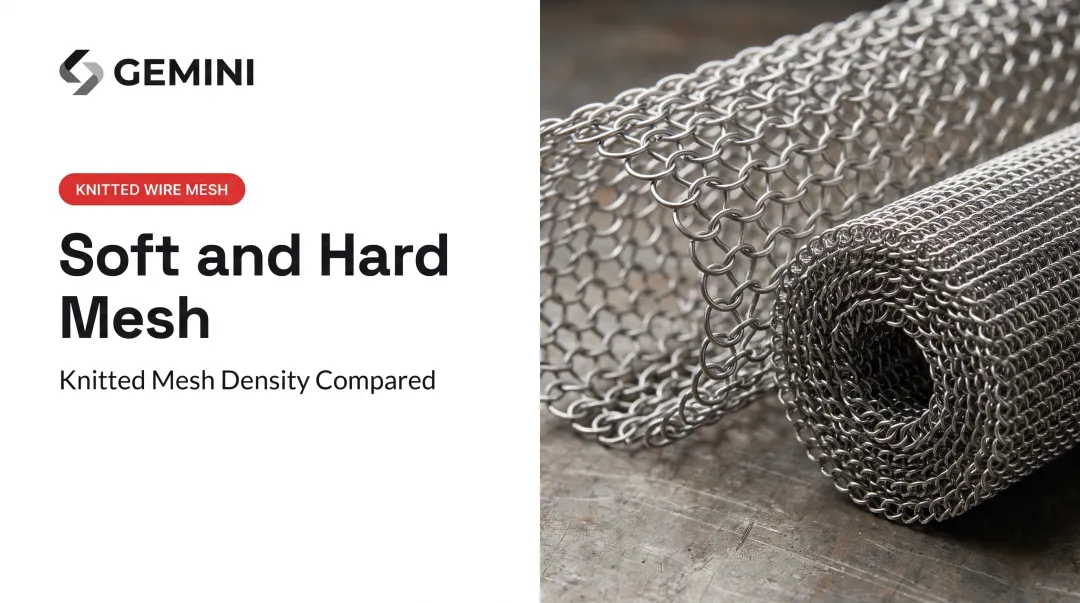
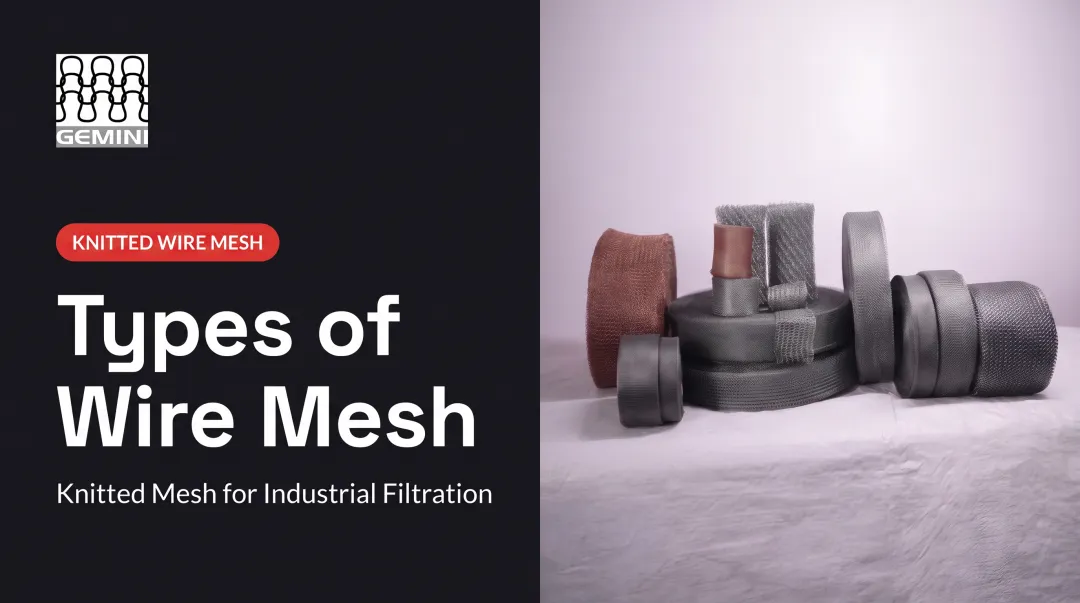
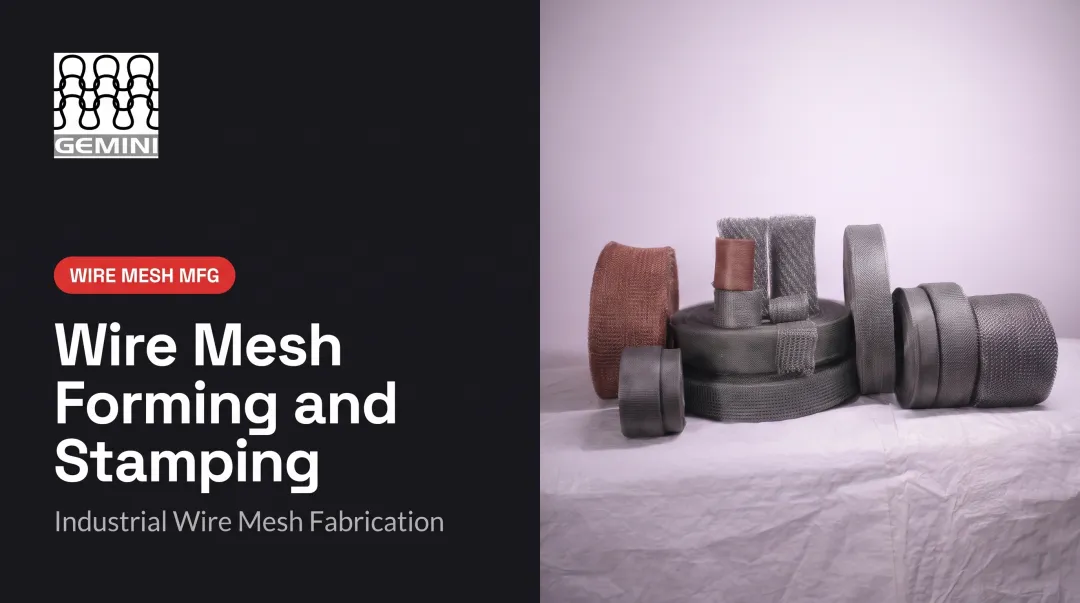
Knitted wire mesh is a related but distinct category. Instead of woven strands, it's knitted from multi-strand wire cables into a dense mesh, then crimped and layered into rolls or bricks. This is where Gemini Wiremesh's manufacturing focuses: knitted column packing built from SS304 stainless steel with a zinc-coated finish, using 0.10–0.30mm wire thickness and 4–5mm openings.
The knitting process creates capillary action alongside high surface area — useful for intimate vapor-liquid contact without the pressure penalty of denser structured formats. It can also be rolled into a single piece for installation, which cuts down on handling damage during a column turnaround.

Cost comparison: No reliable public price schedule exists for comparing plastic, metal, and ceramic packing on a straightforward per-cubic-foot basis. Material choice depends far more on temperature and chemical compatibility than sticker price.
- Metal packing — used where higher temperature resistance is required
- Plastic packing — chemical resistance varies by resin, so material selection has to match the specific service
- Ceramic packing — generally reserved for high-temperature or highly corrosive conditions where metals and plastics both fall short
Get quotes for your specific spec rather than relying on generic per-unit numbers. Packing pricing depends heavily on material, wire gauge, and order volume.
Packed Bed Adsorption: A Related but Different Application
Packed bed adsorption columns look similar but work on a different principle. Instead of gas-liquid contact, they use a fixed bed of solid adsorbent (activated carbon is the most common) to pull contaminants out of a gas or liquid stream.
The EPA notes a typical working capacity for activated carbon of 10-20 lb of contaminant per 100 lb of carbon. Don't confuse this with gas-liquid packing performance — the mechanisms and design math are different.
Key Components of Packed Column Design
Packing material alone doesn't make a column work. It needs the right internals to deliver on its potential.
- Tower body: the pressure vessel that contains everything, sized for the process, not just the packing
- Packing support grid: holds the packing bed up structurally without restricting flow underneath
- Hold-down grid: keeps packing from lifting or shifting at high vapor velocities
- Liquid distributors and redistributors: spread liquid evenly across the column cross-section to prevent wall flow and channeling that cut mass transfer efficiency
- Demister pads / mist eliminators: capture entrained liquid droplets before gas exits the column, protecting downstream equipment and preventing product loss
Gemini Wiremesh manufactures demister pads in SS316 knitted wire mesh, formed into a dense three-dimensional structure that traps droplets while letting gas pass with minimal resistance. They are used across oil & gas refining, chemical processing, and pharmaceutical manufacturing, anywhere entrained liquid needs to stay out of the outlet stream.

Skimping on distribution quality is one of the most common, and most avoidable, design mistakes. You can install the best packing available and still get mediocre performance if the liquid isn't spread evenly across the bed.
Critical Design Factors and Packing Factor
What Packing Factor Actually Means
Packing factor is a manufacturer-provided value representing a packing's resistance to flow relative to how well it supports mass transfer. Manufacturers calculate it from packing geometry and specific surface area, so the value varies significantly by packing type.
At low to moderate liquid loading, pressure drop is roughly proportional to packing factor. According to the Chemical Engineering Progress correlation, structured packing typically carries a packing factor about half that of the lowest-factor random packing options. That difference translates to roughly half the pressure drop under the same conditions.
Packing Factor and HETP
HETP (height equivalent to a theoretical plate) tells you how much packing height you need for one theoretical separation stage. Packing size drives a clear trade-off:
- Smaller pieces raise surface area and can shrink the height you need
- Larger pieces extend the stable operating range
- Larger pieces also weaken mass transfer per foot, so the column may need extra height

Capacity and efficiency rarely peak together. You usually optimize one at the expense of the other.
What Actually Drives Design Choices
Beyond packing factor, several variables shape the right selection:
- Fluid properties — viscosity, density, and diffusivity all affect how efficiently mass transfers across the packing surface
- Flow rate — determines whether you're operating near flooding or comfortably within the stable range
- Temperature and pressure — influence material selection and packing geometry
- Absorption vs. stripping goals — absorption moves a gas component into liquid; stripping pulls volatiles out with heat or vapor. Mass-transfer direction changes which packing traits matter most
A documented example from a gas dehydration case: an existing trayed absorption column was swapped for structured packing at a plant processing roughly 1,400 MMscf/day. Replacing trays with structured packing can increase capacity by 30-50% in cases like this, per research published on the Farashband gas processing plant retrofit.
Common Design Mistakes
- Assuming lower packing factor is always better — it often means lower capacity too, not just lower pressure drop
- Ignoring distribution quality — even great packing underperforms with poor liquid spread
- Selecting packing on cost alone — corrosion resistance and temperature tolerance matter more over the life of the column than the initial invoice
Frequently Asked Questions
What are the different types of packing in a packed column?
Random packing uses dumped shapes such as Raschig rings, Pall rings, and saddles. Structured packing uses ordered geometries—corrugated sheets, gauze, and knitted wire mesh—and typically gives lower pressure drop at higher cost.
What is packing in a distillation column?
Packing is the material inside the column that provides surface area for vapor and liquid to contact each other. More contact area generally means better separation efficiency per unit of column height.
What is the difference between a packed column and a tray column?
Packed columns generally run at lower pressure drop and lower liquid hold-up than tray columns. Trays tend to handle high liquid-to-vapor ratios and high-pressure distillation more comfortably.
What is a packed bed adsorption column?
A packed-bed adsorption column is a fixed bed of solid adsorbent, such as activated carbon, used to remove contaminants from a gas or liquid stream. Unlike absorption packing, it relies on surface adsorption rather than continuous liquid contact.
What is an absorption column?
An absorption column uses a liquid to capture a specific gas-phase component as it rises through the tower. Packing provides the surface area needed for that gas-to-liquid transfer to happen efficiently.
What is the difference between stripping and absorption?
Absorption transfers a gas component into a liquid stream. Stripping does the opposite: it removes volatile components from a liquid using heat or a vapor stream.