This confusion trips up a lot of buyers searching online. Textile crafters knit with metallic thread for jewelry or decorative pieces. Engineers, on the other hand, specify knitted wire mesh for filtration, sealing, and shielding in industrial equipment. This article covers the engineering material: how it's made, what makes it structurally unique, and where it shows up across industrial applications.
Key Takeaways
- Knitted metal loops continuous wire into stitches—not woven or welded mesh
- Looped structure delivers up to 300% stretch and 98% void volume porosity control
- Core applications: mist elimination, gasketing, EMI shielding, acoustic dampening
- Materials span stainless steel, copper, and specialty polymers such as PEEK
What Is Knitted Metal? (Definition & How It's Made)
Knitted metal mesh is a three-dimensional, fabric-like structure created by looping continuous wire into interconnected stitches. Picture a knitted sweater, but instead of wool, the "yarn" is fine-gauge metal wire.
Manufacturers produce it on circular wire knitting machines, where wire feeds through a cylinder head and forms consistent interlocking loops. Three common mesh constructions differ in how the wires connect:
- Knitted mesh: wire forms interlocked loops, similar to textile knitting
- Woven mesh: straight wires interlace over and under each other in a fixed grid
- Welded mesh: wires are electrically fused at each intersection point
That looped construction gives knitted mesh its defining trait: it stretches, compresses, and conforms to irregular shapes without losing structural integrity. A flat sheet of welded mesh can't do that. Neither can woven mesh, which holds a fairly rigid, permanent aperture.

Wire Materials, Density, and Stretch
At Gemini Wiremesh, knitting equipment achieves up to 300% stretching capacity and density control ranging from near-zero to more than 98% void volume. That range matters because it means the same base process can produce a tight, dense filtration pad or an airy, high-porosity demister element, just by adjusting loop count and wire diameter.
Common wire materials include:
- Stainless steel (SS304, SS316, SS316L)
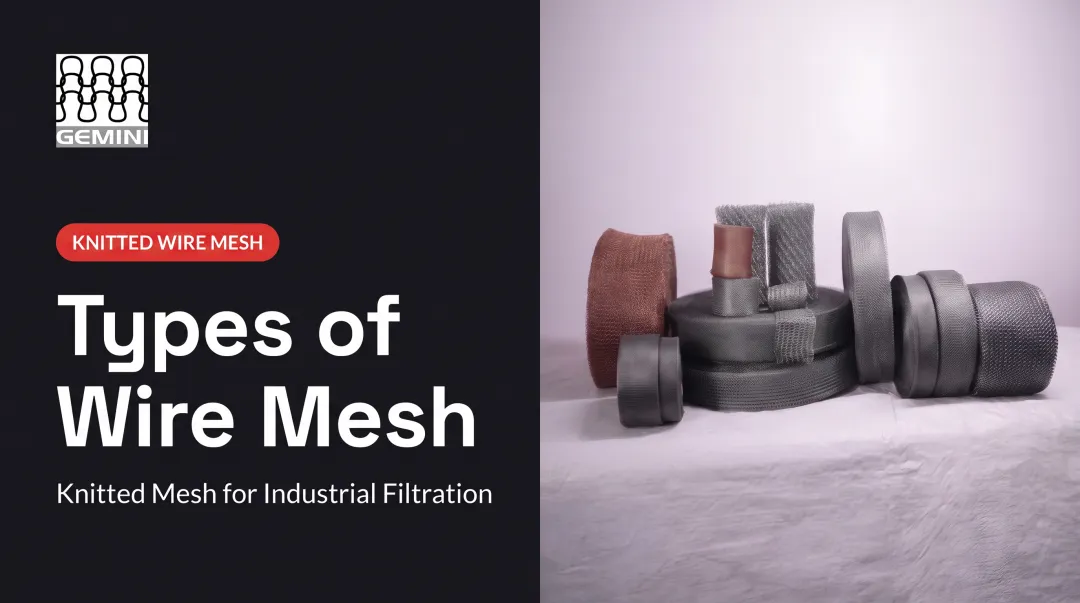
- Copper and tinned copper
- Aluminum and galvanized steel
- Specialty polymers like PEEK for aggressive chemical environments
Wire thickness for most industrial knitted mesh runs between 0.05mm and 0.36mm, fine enough to knit densely, thick enough to hold up under mechanical stress.

Key Properties That Make Knitted Metal Unique
Compressibility and Resilience
Because the loops interlock rather than lock rigidly, knitted mesh compresses under load and springs back once released. This makes it valuable for gaskets and vibration-damping components where a rigid material would crack or fail to seal properly.
Porosity and Density Customization
Engineers can dial in void volume with precision. A tighter knit produces denser mesh for fine filtration; a looser knit produces high-porosity mesh —up to about 98% void volume—for airflow applications with minimal pressure drop. The same manufacturing process handles both extremes.
Corrosion and Temperature Resistance
Material selection drives performance here:
- SS316/SS316L — strong resistance to chlorides and corrosive process chemicals
- Copper and tinned copper — excellent conductivity for shielding applications
- PEEK and specialty polymers — for environments where even stainless steel degrades
Stainless steel knitted mesh is highly recyclable at end of life. Industry estimates put recovery at around 95%, a general figure useful when comparing lifecycle impact across materials.
Flexibility and Formability
Multi-directional stretch (up to 300% in some constructions) means knitted mesh can be shaped into demister pads, wrapped into gaskets, or rolled into cylindrical filter elements. Rigid mesh types can't be formed this way without cutting or welding seams.

Common Industrial Applications of Knitted Metal
The same looped mesh structure serves filtration, sealing, shielding, and insulation roles across heavy industry.
Filtration and Mist Elimination
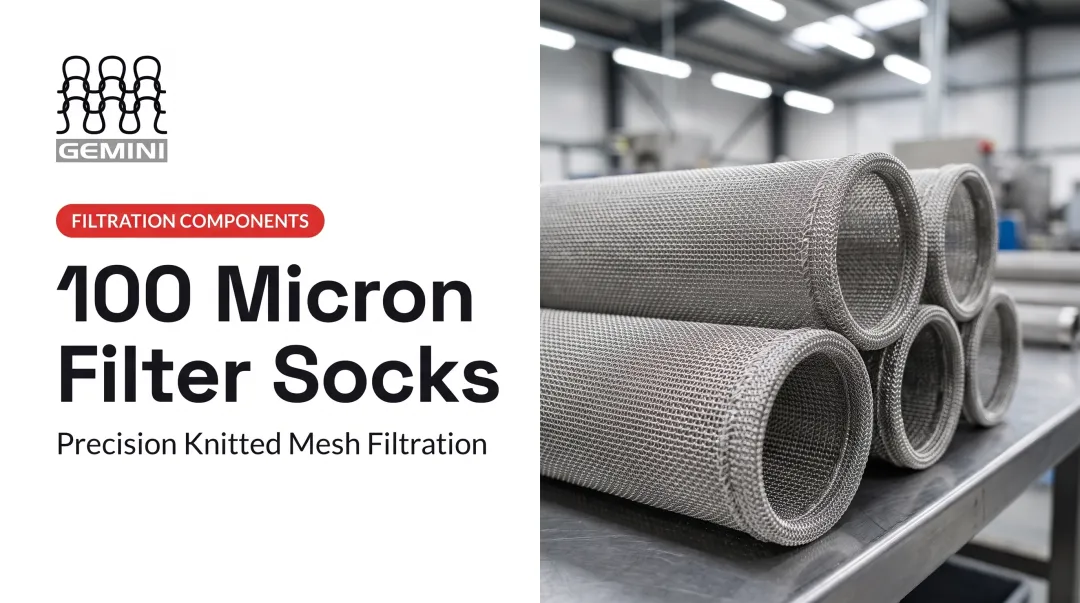
Compressed into pads, knitted mesh becomes the core component of demister pads used in scrubbers, separators, and knock-out drums. These pads remove liquid droplets from gas streams before the gas moves downstream, protecting compressors and other equipment from damage.
Commercial mist eliminators using knitted mesh construction have been documented collecting liquid particles in the 2-5 micron range in oil and gas processing applications. Performance in practice depends heavily on wire diameter, mesh density, and gas velocity, so specifying the actual test conditions matters more than any generic percentage claim.

Gasketing and Sealing
High-temperature, high-pressure joints need a gasket that compresses evenly and keeps its seal through repeated thermal cycling. Compressed knitted mesh fills that role in exhaust flanges, turbine joints, and process equipment where elastomers would harden or burn out. The open structure conforms to uneven surfaces while the metal resists heat and chemical attack.
EMI/RFI Shielding and Grounding
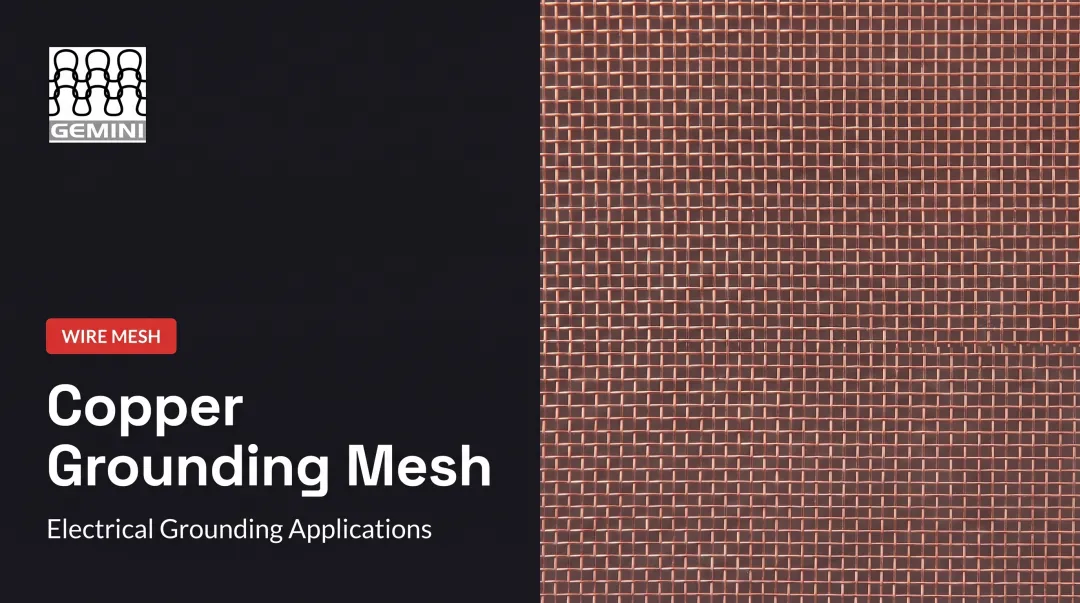
Knitted mesh and tinned copper braid get embedded into electrical connectors and shielded enclosures to block electromagnetic interference. Shielding tapes and flat braided connectors from Gemini Wiremesh are used for grounding and static-discharge paths in electronics and industrial automation assemblies.
Insulation and Acoustic Dampening
As a facing or reinforcement layer in removable insulation blankets, knitted mesh adds structure without sacrificing flexibility. It also absorbs vibration and sound in machinery applications where rigid materials would transmit noise instead of dampening it.

Knitted Mesh vs. Woven and Welded Mesh
| Construction | Structure | Best For |
|---|---|---|
| Knitted | Interlocked loops, highly flexible | Demister pads, gaskets, conformal shapes |
| Woven | Interlaced warp/weft, rigid grid | Precise, stable screening apertures |
| Welded | Fused intersections, most rigid | Structural or load-bearing grids |
Knitted mesh fits best when an application demands compressibility, stretch, or 3D shaping. Woven mesh delivers tighter aperture precision. Welded mesh provides the rigidity and load-bearing strength the other two can't match.
One limitation: knitted mesh generally isn't the right choice for structural load-bearing use. Its strength comes from flexibility, not rigidity, so don't specify it where a fixed, high-tensile grid is actually needed.
How to Choose the Right Knitted Metal Mesh Supplier
Not every mesh supplier can deliver consistent quality at scale. A few things worth checking before you commit to a vendor:
- Certification and quality standards — Look for ISO 9001:2015 certification, a benchmark for consistent manufacturing and process control.
- Customization range — Confirm the supplier can adjust density, wire gauge, and alloy type to your exact process conditions—not just a catalog of standard sizes.
- Specialty material capability — Ask whether they can knit polymers like PEEK to a tight spec in smaller runs; few will, and Gemini Wiremesh handles work standard mesh manufacturers typically decline.
- Logistics and experience — Favor suppliers with decades of manufacturing history and a track record of consistent global delivery to cut supply-chain risk.
Gemini Wiremesh is based in Mumbai and has more than 30 years in knitted mesh manufacturing. Facilities with direct access to Jawaharlal Nehru Port Trust (JNPT) help keep lead times manageable for US process-equipment fabricators and distributors.
Frequently Asked Questions
What is knitted fabric material?
Knitted fabric material refers to any material, including metal wire, formed into interlocking loops using knitting techniques. This creates a flexible, stretchable structure regardless of whether the base material is yarn or fine wire.
What metals are used in knitted wire mesh?
Common metals drawn into wire for knitting include stainless steel, aluminum, copper, and specialty alloys like Monel. The choice depends on required strength, corrosion resistance, and the specific application.
Is knitted metal mesh the same as woven wire mesh?
No. Knitted mesh uses looped construction for flexibility and stretch, while woven mesh uses interlaced strands for a rigid, fixed-aperture grid. They suit different applications.
Can knitted metal mesh be customized for specific industries?
Yes. Density, wire diameter, and material can all be tailored to meet exact filtration, sealing, or shielding requirements, whether for oil and gas, pharmaceutical, or electronics applications.
What industries commonly use knitted wire mesh?
Oil and gas, aerospace, automotive, electronics, and pharmaceutical industries all use knitted wire mesh for filtration, EMI shielding, and insulation applications.
Is knitted metal mesh eco-friendly?
Most stainless steel knitted mesh is highly recyclable and non-toxic, making it a sustainable choice compared to single-use filtration materials in many industrial settings.